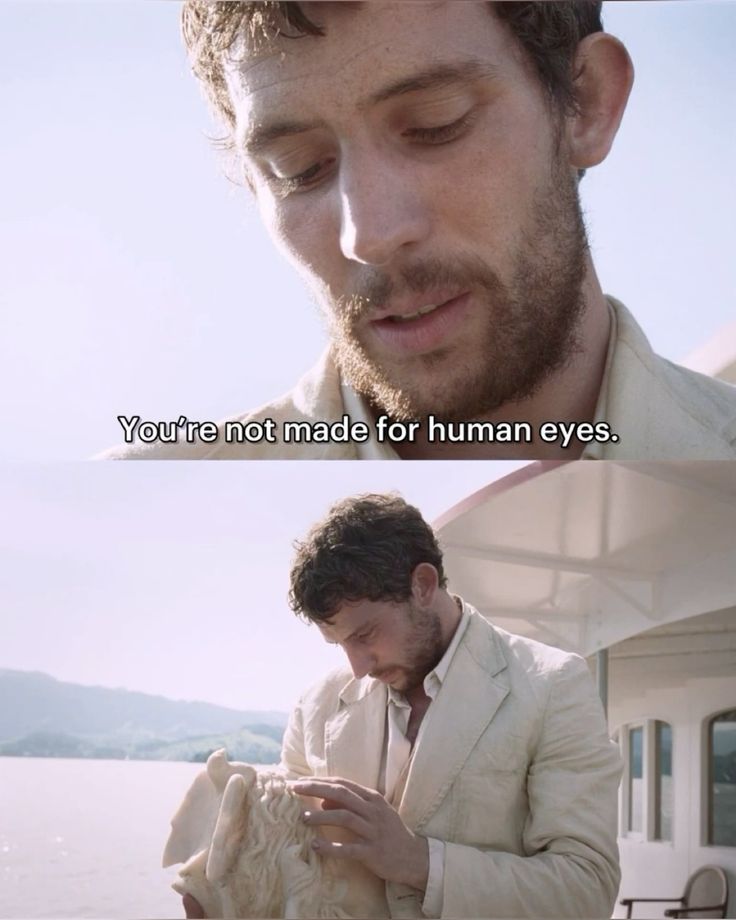
I went to see this film with no planning or research done ahead of time. I did not know what it was about, who directed it or whether or not I was actually interested. All I knew was that Josh O’Connor, an actor whom I like and admire played the lead. My two friends, Bruna and Bella, invited me, while in line we argued about whether it’d be in French or Italian. It turned out to be Italian and English.. We were all slightly wrong.
For whatever reason the film moved me in ways I could not entirely explain, it reawakened my passion and love for archeology, as well as my tenderness for moody and unlikeable protagonists. I was completely taken by O’Connor’s effortless performance and Rohrwacher’s minimalistic directing. I could not bring myself to rate it anything lower than a five on Letterboxd, it quickly became a favourite of mine. Raving about it immediately when I got home.
The film follows Arthur a grumpy British archeologist, set in the backdrop of 1980s Tuscany. O’Connor played an aloof, disillusioned man that seemed to be broken by something, perhaps it was his mystical gift of finding the exact location of long lost treasures? Or the red thread that hung from the dress of his girlfriend? Arthur and a group of grave robbers dig further and further into Italy’s mystical underbelly, pulling out forgotten sculptures and jewels. While Arthur is unwilling forced into the present, we can see his mind wandering towards the past. Particularly, to the beauty of ancient objects that he sells to collectors but more so, to his recent past, a past that was portrayed by Rohrwacher as sunny and calm.
If you have read my most recent post, you would know I have a deep fascination with directors that like to play with time, Rohrwacher is one of those directors. She plays with it in a way that is not always clear to many viewers, it is unconventional and lacks linearity. She uses the past and present as not a barrier, or a memory, but as if the two were blankets stacked on top of one another, both accompanying one another and making the viewing all the more warm.
The actual plot is one that is not as clear, much like the title. At the start of the film we find Arthur returning to Tuscany, it is hinted at (but not shown) that he had spent some time in prison. He connects with his girlfriend’s mother, Flora, in a ruin-like house. There he meets Flora’s maid/singing student, Italia. As if it were immediate, there was a quiet spark between the two. Which is woven together through Italia’s awkward gestures. While this romance flourishes, Arthur and his group continue to pull off their stunts, mocking others as they climb into graves and steal what is not theirs, or as Italia tells our protagonist, “not made for human eyes.” Eventually Arthur rebels against them, pushing away his cursed gift of divination.
The beauty of this film, though, is not just within its characters or its minimal dialogue. It comes from Rohrwacher’s indescribable genius. The texture and quality that was taken from shooting with different film stocks, sped up moments of Arthur walking, expressing his frustration towards his friends and towards his own choices, the use of almost a ‘chorus’ that narrated bits and pieces of La Chimera. The diegetic traditional Italian band that played during certain scenes pared with the contrast of the non-diegetic electro-pop music while Arthur dived into graves. It’s a brilliant combination of ancient and modern that left me yearning for more.
The tug of opposing forces is a key theme in La Chimera. The purity of the art versus the act of stealing and selling, life and death, but the centre of this is Arthur’s inner battle; choosing whether or not to let go of his first love (the red string that hangs off her knitted dress which seems to continuously unravel, his last memory of her) or to allow himself to accept new love.
This film, did not feel like I was watching something. I felt inside of something. Despite, Arthur’s dislikability, I found myself routing for him, hoping he would see the light within Italia, if not her, then maybe himself. It had a distinct feeling to it that was reminsisent to directors like Varda and, in some way, Kieslowski. The phantom styled protagonist, the use of angles to portray emotion. The show and not tell of it all. The subtly and deep minimalistic pain Arthur showed throughout the film, made me wonder why no one was talking about it; why, in recent years, this quiet emotion, was not being shown in film anymore?
 Deep Sea Diver
Leave a comment