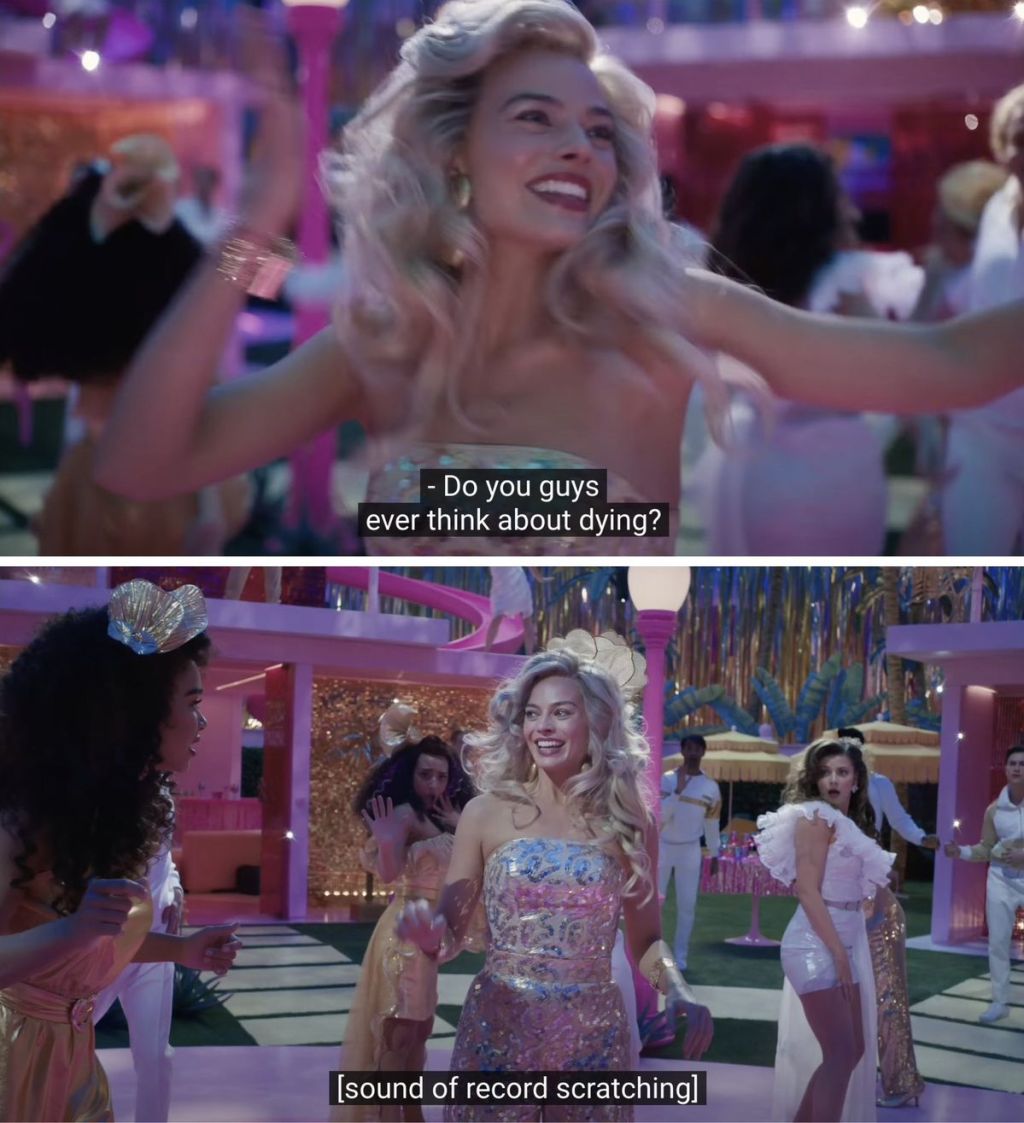
Now look, before I begin this essay I would like to make one thing clear- I do not dislike or have any sort of animosity towards these directors. In fact, I respect them and recognise how truly difficult it can be to break into an industry that is dominated by men. What they’re doing, is certainly admirable and has inspired many young girls to pursue a career in cinema, and that, I think is the most important part of the role they play within contemporary society.
Here is where the issue lies, the contents of their films, in my personal opinion, has left me unimpressed and frankly disappointed.
Gerwig’s Barbie (2023), for example left me wondering why this was marketed as a ‘radical’ film, as if it shifted the culture of what it means to be a woman. And in some sense, it did. But not in a way that many people believe, it barely touched the surface of what it means to be a ‘woman’, intersectionality did not seem to be a part of this film at all. It does not feel as innovative or inclusionary as it was marketed, it felt like ‘choice feminisim’ (something that is worryingly a growing trend on social media at the moment)or to put it in simpler terms, white feminism.
To break down what white feminism is to it’s core is that it prioritises the needs of cis-gendered, straight white women, mainly the needs of the individual rather than fighting for other groups’ liberation from oppression. In other words, it is a rebrand of 2nd Wave Feminism, fighting for the freedom of a small percentage of women from the patriarchy while ignoring other groups (disabled, trans, people/women of colour etc.).
Now I will give Barbie (2023) it’s credit where it is due, it gives us a great entry level summary of what Feminism and the patriarchy is. It portrays the patriarchy exisiting on many levels, institutionally, culturally and our own relationships within current society. When Barbie enters the real world, immediately she is a victim of gender based oppression, with cat calling and the ‘male gaze’. On the other hand, it directly benefits Ken, learning about the advantages men get within the real world (sports, being uplifted in the corporate world and media). This contrast and sewn together story lines shows us in multiple ways, how vulnerable and easily both groups can be affected by a patriarchal society.
Here is where it gets complicated, recognising that Barbie, a cisgendered white main character is at the for front of this, the two other main characters are two women of Latin descent. But rarely are their own problems mentioned. It is about Barbie’s experience (which makes sense) but if we look at Barbie’s world, her surroundings, the wide array of different barbies etc. Shows us that Gerwig HAD the capacity to show a different point of view, but (whether or not it was deliberate) did not.
We are shown tidbits of diversity but it’s never truly touched on or spoken about. Gerwig herself, has been accused of being a white Feminist, only ever directing films that portray the white female experience. Some fans defend her work, stating that she writes from her own experiences and that one could not expect to her to write or create anything outside of that as art is inherently personal. This is a baseless and passive argument, it gives directors and Western culture a pass to not remotely attempt to understand or embrace other cultures or stories outside of their own personal lives.
It is also, frankly, an argument that does not hold up realistically as French screenwriter/director Celine Sciamma created Girlhood (2014) that presented a predominantly Black female cast. She herself has emphasised the intentional choice of Black women in her film, due to the lack of Black representation in French film. Although this isn’t a new approach but it is an example that white women do not ALWAYS have to be the centre of feminist film.
To portray Gerwig’s films as a universally relatable idea of womanhood is naive and exclusionary, it fails to acknowledge other struggles, and falters to add true, meaningful depth.

Fennel in my mind, struggles with this same issue; a lack of depth and an unwillingness to understand life outside of her own experience. Saltburn (2023) was visually and aesthetically a beautiful film, these are her strong suits. It’s obvious with her upcomming ‘Wuthering Heights’ (2025) film and with Promising Young Woman (2020).
But she falters when it comes to substance, she attempts to show the difference between the 1% and the working class but fails hopelessly. Seemingly too focused on how the movie looks rather than what it is attempting to tell us. Fennel tries to shock us with odd sex acts, which has worked for mainstream society. As many deemed it as ‘horrifying’ or completely out there.
Not to sound too pretentious, but I can name at least four films that are far more shocking than Saltburn but people have to have a base down for cinema, right?
I don’t have a problem with sex and sex acts in cinema, especially when it’s used in a way that exemplifies class struggle (or struggle in general, ie Anora (2024)).
What I do have a problem with, is being shocking for the sake of being shocking. These acts are useless to the plot, there is no true meaning behind the acts, it appeals to the main aesthetic of the film, not the message. Emerald Fennel is so desperate to be seen as innovative and different to her peers but in the end, it comes off as if she is performing for mainstream society.
The message of the film was supposed to be an ‘eat the rich’ critique on capitalism and the 1%. But it seems that message got left in translation, instead the glorification of ‘old money’ is back, and Fennel, unfortunately, is apart of this trend.
This idea of ‘the class system is absurd’ is at its core champaign socialism, it’s only absurd because the group saying this, does not suffer from the class system. Fennel lacks self-awareness is so glaringly obvious. she did not attempt to understand Oliver’s (the main character) struggle with his identity, she did not even try to add any depth to his character.
But how could she? An oxford educated privileged white woman with a wealthy background, she doesn’t need to understand it, she can sexualise and aestheticise it as much as she likes and people will deem her a genius for it. It begs the question, can rich people understand a class beyond their own? Are they willing to understand it? Can they read marxist theory and understand socialism even though it doesn’t necessarily ‘benefit’ them?
The answer is a hopeful yes, if they take the time to. Which many do not, instead they romanticise and infantilise the working class. As it was done in Saltburn, viewing them as pitiful, meek creatures. It’s depressing! There are many socialist films such as, Parasite (2019), that can and HAS depicted the class struggle in a fantastically beautifully way. While also relaying aesthetic and colour grading into the style without taking away from the message behind the film.
Fennel has shown us time and time again she is unable to do this. Her obsession with shocking and disgusting the audience is something she is too focused on, one does not need shock and an “absurd” aesthetic (an incredibly ignorant one at that) to draw a point across.
I single these women out not because I am completely against their work, but because as two of the most currently popular female directors at the moment, I expect more. Much more. And yes, they are a start, and their films, (speaking as a cinephile), is a great way to get into contemporary film. But they should not be put on a pedestal and praised simply because they are female directors, frankly, I find it condescending.
I’ll leave it with the trailer to a personal favourite film of mine, The Watermelon Woman (1996)
 Deep Sea Diver
Leave a comment